Inspired by the historic Black Wall Street District in Tulsa, Tamesha Ways, a South Jersey entrepreneur, aims to celebrate Black business, culture, and community through the inaugural Black Wall Street Experience, a highly anticipated networking and vendor event slated for July 11 at Elevations Suites – Event Venue in Blackwood, NJ.
Monique Howard
From Berlin Borough Hall to the Streets:Protesters speak out at “No Kings” Rally
Berlin, NJ – On a chilly Saturday afternoon, protesters carrying signs denouncing the President and ICE (Immigration and Customs Enforcement) marched from Berlin Borough Hall to Berlin Park, where a rally was held, featuring speeches that echoed a nationwide call for change.
Cross Keys Crusade for Democracy draws support and opposition in Sicklerville
by Monique Howard
South Jersey Emerging Journalists Project
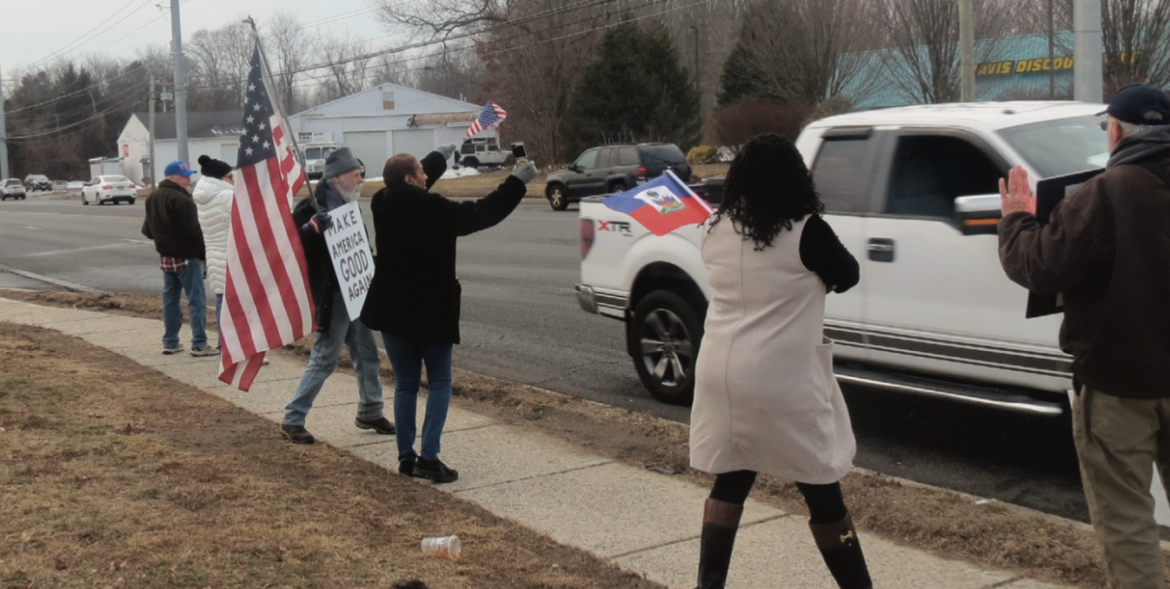
SICKLERVILLE, NJ — The Cross Keys Crusade for Democracy took place on February 18, 2026, and is one of many grassroots protests that have occurred across the state, where people share the sentiments of a nationwide movement opposing ICE (Immigration and Customs Enforcement) tactics and other alleged aspects of government overreach.
Recently, rallies have occurred in Lindenwold, Clifton, and Roxbury.
On this cloudy Wednesday afternoon, protesters gathered along the sidewalk on Berlin–Cross Keys Road near the local ShopRite. The small crowd, toting signs denouncing ICE and the President, garnered support from many drivers passing by who honked their car horns to show solidarity. However, not all drivers on the road that afternoon agreed with the demonstration. A few enraged drivers shouted profanity at the protesters and gave them the middle finger. An attendee, Cory, was alarmed by what he considered unnecessary aggression from some drivers passing by. “I just can’t believe, standing out here now, how many people are so angry that we’re here,” he exclaimed.
Despite some of the negative responses, the protesters remained resolute as upbeat music poured from a small stereo set up in the grass nearby.
Under the guidance of Mary, volunteer organizer of the Cross Keys Crusade for Democracy, this peaceful rally served as a “wake-up call” to raise awareness of unjust policies, civil rights rollbacks, and attacks on the First Amendment. To protect individual privacy, the volunteer organizer and some participants agreed to share their thoughts, but requested that their full names be withheld.
“I’m trying to provide an opportunity for people to come out and increase visibility to show our opposition to, you know, the madness that’s going on,” Mary stated. “There are so many issues. So many of the policies are just inhumane and cruel.”
She added, “The fabric of our democracy is just being torn apart, and people are oblivious to it. They have their heads in the sand. So we really just want people to wake up.”
Like many others present at the rally, Greg expressed his frustration with what he perceives as corruption. “Our President is making a mockery of the law,” he said. “He is a criminal, and he belongs in jail, and our Congress is impotent to do anything about it.”
As with Mary, Greg also hopes to shed light on issues surrounding the political climate and help create change. “Donald Trump is using ICE as his personal Gestapo and targeting citizens and noncitizens alike, and he must be stopped,” he said.
Another attendee, Patricia, agreed to share her thoughts about ICE.
“I’m really upset about all the hate and all that ICE is doing,” she said. “The people need to be monitored. We need to move into a positive place.” She continued, “I want to encourage all people to support all the bills in Congress in opposition to ICE.”
This story is produced as part of the South Jersey Emerging Journalists Project fellowship, in partnership with Temple University’s Center for Community-Engaged Media and is supported by funding from the People’s Media Fund and the NJ Civic Information Consortium.
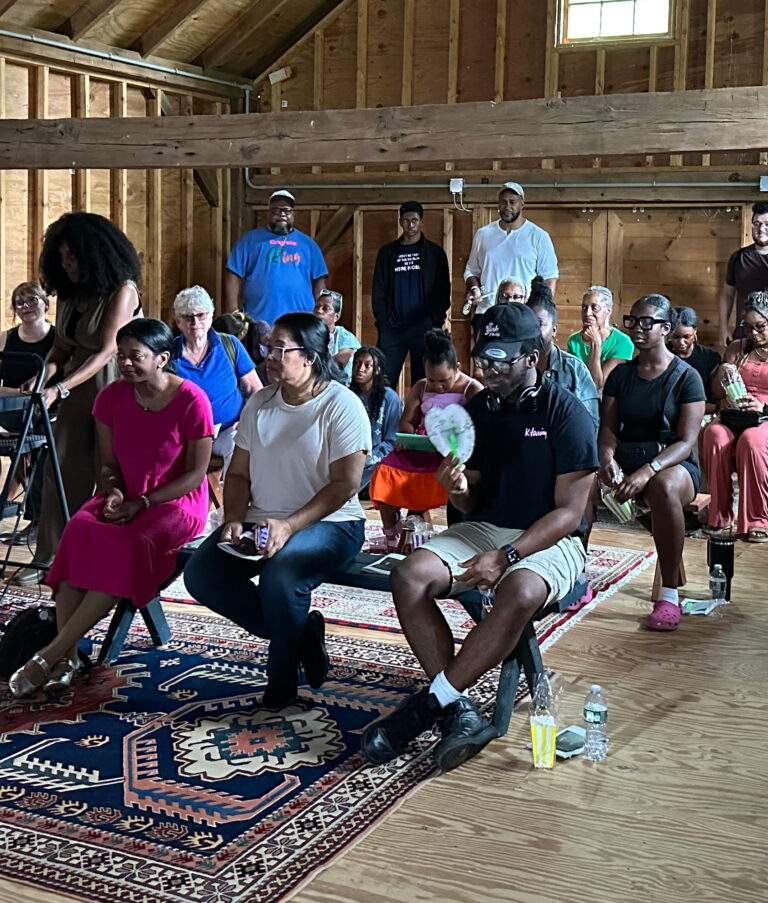
On June 28, Our Farm By the Creek LLC and Heart and Crown Wellness LLC partnered with Third Culture Kid Media (3CK) to host “Screen & Relax” on a sunny Saturday afternoon.
The charming farm, nestled within sprawling acres of land and dotted with trees, not only provided the venue for the screening of “War is Never Civil” but also served as its filming location.
By Monique Howard
WESTVILLE—In 1921, Louis Grossman, the owner of an oil and gas store in North Woodbury, initially organized the Helping Hand Fire Company.
Founded in 1922, the Helping Hand Fire Company’s legacy has stood the test of time as one of the oldest African American volunteer fire companies in the state of New Jersey.
The fire company was incorporated in 1924, and during that time, the core members serving were John Long (President), Loen Corsey (Chief), Harrison Tull (Treasurer), Ed Bonds (Secretary), Oscar Brown, Riley Davis, John Fletcher, George Corsey, Herb Corsey, and Dennis Huffington.
For firefighter and historian Bryant Fiddler, the Helping Hand Fire Company is a generational legacy of service and sacrifice.
“Our initial meetings were either at members’ houses or the president’s house,” Fiddler said in an interview with Front Runner New Jersey.
“My great-grandfather, he ended up being a president later on, but they would have it at his house because he owned the store. Many meetings were held at the church. Our first firehouse was built in 1925, so we operated for a couple of years without a home. We got our first truck in 1924 from a fire company in West Deptford.”
The history is marked by brotherhood, bravery, and a long-lasting commitment to the local community.
Today, Tim Wagner is the president and serving his third year guiding the cherished fire company for a new generation. Erv Jerkins served as president prior. Wagner grew up in a close-knit neighborhood where the Helping Hand Fire Company was upheld as the cornerstone of the community. Steeped in a rich history, the fire company sparked the curiosity of many young men, and it became a haven for them.
Since the age of 15, Wagner has been a part of the Helping Hand Fire Company and many of his friends and family members.
“It’s kind of like a brotherhood,” he said. “So it projected me into an area where I am now because I saw positive gentlemen. These guys have pensions, they’re retired. They go to work and do what they’re supposed to do to take care of their families. We see that, and it reflects down here positively.”
He attributes the fire company’s longevity to having solidarity with the local community. Whether it’s cutting the grass in the community or standing up to injustice, the Helping Hand Fire Company remains true to its name.
“Everybody likes to come down here,” he states. “It’s the community place where if somebody is having a repass, they have it here and things of that nature. We help out when we can, and it makes me proud to be one, the president, but also a part of this firehouse.”
In addition to assisting the community, the fire company is also beneficial to the township.
“A lot of people think that the fire department is paid, and probably 70 percent of fire departments in the United States are volunteers,” he explains. “In big cities, they have paid staff.”
“We help the township with a tax problem because if something happens and they shut down the volunteer fire departments, now they have to pay staff,” he continues. “They have to raise taxes to fund this. We’re talking 19 guys, an engine, a ladder, and rescue around the clock. We’re talking two to three million dollars. There’s been some legislation trying to go through the state of New Jersey where we could get our taxes cut maybe in half so that type of benefit could get more people to come out.”
The Helping Hand Fire Company gains funding through donations, hall rentals, and renting the engine room to Deptford Township for storage.
Despite the historic milestone of reaching 100 years and the celebrations held to commemorate this achievement in 2022, the Helping Hand Fire Company continues to struggle with acquiring new recruits.
“Kids don’t like to go out and play anymore or just get involved,” Wagner said. “So it’s very hard for us to recruit. The kids are not interested. It’s difficult to compete with Xbox and PlayStation.”
Not deterred, he continues by adding, “We continue to try. We reach out to schools. We go door to door and pass out fliers. We try and hope and pray.”
Presently, three young cadets ages 12-13 years old have joined the Helping Hand Fire Company. The youngsters visit the fire department every other Wednesday and are allowed to ride the firetruck. Once a cadet reaches the age of 15, they can actively participate and wear firemen gear. Wagner remains hopeful that youth who come to the fire department will reach this pivotal moment and remain committed.
Wagner believes time and dedication are the two key factors necessary to become a fireman. After successfully completing the required classes, a cadet will be accepted.
“It’s definitely worth it if you like to help people,” he commented. “You’re serving your community, you’re serving your township, you’re serving your state and your country. It kind of fulfills all that.”
Washington Township civil rights attorney Stanley King champions for justice
By Monique Howard
WASHINGTON TOWNSHIP — Originally from Brooklyn, New York, civil rights attorney Stanley King was given the opportunity as an undergrad to serve in an internship with the United States Commission of Civil Rights. As an intern, he worked with Ebenezer Baptist Church (which was pastored by Martin Luther King Jr.) and the surrounding community. In addition to serving at this historical landmark, he devoted time to the King Center and the Southern Christian Leadership Conference.
The inspirational places King visited and the people he encountered during his academic career left a lasting impact on his life and would ultimately help shape his future.
“I was immersed in the thought and idea of civil rights and the work and the efforts that were being put forth by others to level the playing field,” he said in an interview with Front Runner New Jersey. “Then after that, I graduated from Oglethorpe University.”
After working various corporate jobs, he decided to attend Rutgers-Camden Law School, and from there, he represented professional athletes such as baseball player Ray Lankford and many others for several years.
“I simultaneously got back to where I hopefully belong between the struggle for equity and civil rights,’” he explains. “And then my wife and I launched a practice together, and we collectively decided that we wanted to help those who get overlooked in the legal system.”
The couple’s law firm, King & King, is located in Woodbury, New Jersey. Stanley and his wife Sharon worked together for over two decades before she went on the bench in 2021.
Championing for justice does not come without obstacles and unfavorable circumstances, as King has learned firsthand.
“We’ve handled some very difficult, trying cases involving the deaths of people at the hands of police,’ he recalls. “So there’s a certain amount of emotional attachment you have to a family who’s grieving the loss of a loved one, and there’s a certain amount of rage that you have associated with the circumstances surrounding their death more often than not.”
King continues by adding,” It’s senseless, but for the fact that the person who ultimately passed away was not treated with the type of dignity or respect that would be afforded to other similarly situated American citizens, they would still be alive. We’ve handled probably close to 10 wrongful deaths, particularly by African American men at the hands of police.”
King defines his profession as a “Utilitarian undertaking” when considering advice to those who might be considering becoming a lawyer.
“We definitely need more African American lawyers in particular,” he said. “The challenges that face us currently need to be addressed, and we need people in the court to champion those causes. Hopefully, I can bring light to some of the things that are happening. Hopefully, all that was gained in the struggles throughout the years will not be reversed. “
After reflecting on the attack on diversity in the current administration, King offered a piece of advice.
“If we have an opportunity to make this country and our workplaces and schools a more inclusive environment, we should act definitively to make that happen,” he states. “ If, in fact, we would look outside of the norm, which is to always hire and promote and do things that only positively affect one race, one gender, then it is less inclusive. We need to look at other people of color and other sexes in order to create an environment that’s more rich, more universal in its appeal and its application.”